OT security encompasses the safety practices, architectural frameworks, and cybersecurity technologies designed to monitor, detect, and protect physical industrial assets, equipment, and processes. It safeguards operational technology environments—including industrial control systems and supervisory control networks—from cyber threats, unauthorized modifications, and operational disruptions.
Key Points
Physical process protection: Industrial security safeguards cyber-physical assets that execute physical operations, ensuring worker safety and preventing physical destruction.
Operational uptime priority: Security measures prioritize continuous availability and real-time reliability over traditional data confidentiality.
Legacy system coverage: Frameworks extend protective controls to unpatchable legacy devices, programmable logic controllers, and human-machine interfaces.
Protocol-level visibility: Monitoring relies on deep packet inspection to decode proprietary industrial protocols without disrupting live control traffic.
Zero Trust segmentation: Modern architectures enforce strict network segmentation to prevent lateral threat movement across converged IT and OT environments.
OT Security Explained
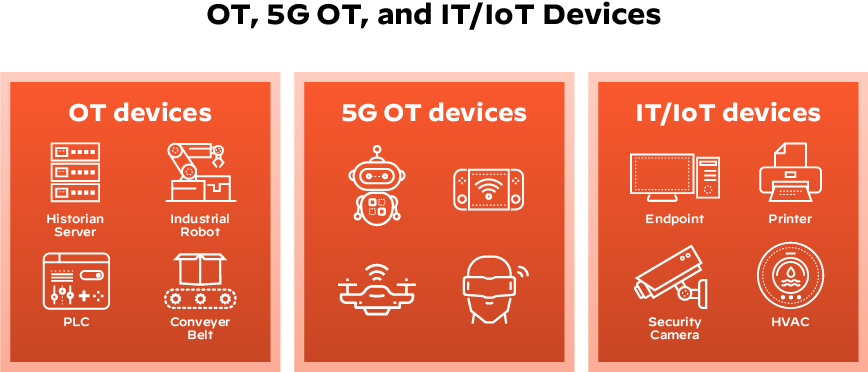
Operational technology security addresses the unique technical requirements of networks that manage physical hardware across manufacturing plants, electrical grids, water utilities, and transportation systems. Unlike standard enterprise computing, operational systems directly manipulate physical processes using sensors, actuators, human-machine interfaces, and programmable logic controllers.
Figure 1: OT, 5G OT, and IT/IoT devices
Cyber incidents within operational environments introduce physical safety hazards, severe environmental damage, and costly production downtime. Securing these physical processes requires specialized monitoring techniques that inspect proprietary control traffic while maintaining continuous physical operations.
Modern industrial architectures integrate continuous asset discovery, threat monitoring, and zero trust network policies to safeguard physical processes against targeted attacks. Establishing non-intrusive visibility allows security teams to identify vulnerabilities across legacy infrastructure without interrupting time-sensitive control loops.
Key Differences Between OT Security and IT Security
Understanding the IT vs. OT security differences is essential for aligning corporate security policies with industrial field requirements:
Information technology security focuses on data privacy, confidential records, and user access across corporate networks.
Operational technology security prioritizes human safety, physical asset protection, and continuous system uptime.
Operational Attribute
Information Technology (IT) Security
Operational Technology (OT) Security
Primary Core Objective
Confidentiality, Integrity, and Availability (CIA Triad)
Availability, Integrity, and Safety (AIS Triad)
System Lifespan
3 to 5 years standard hardware lifecycle
15 to 30+ years legacy operational lifespan
Patch Management
Frequent, automated operating system updates
Restricted schedules, manual vendor validation
Performance Tolerance
Accepts minor latency and occasional reboots
Zero latency tolerance; deterministic execution
Primary Impact of Breach
Data exfiltration, IP theft, financial losses
Physical destruction, worker injury, downtime
Communication Protocols
Standardized network protocols (TCP/IP, HTTP)
Proprietary protocols (Modbus, DNP3, OPC UA)
Convergence of IT and OT
Historically, IT and OT were managed by separate groups in an organization. IT and OT did not share interdependencies. However, in recent years, the paradigm has shifted.
Today, it’s common for OT systems to be provisioned with networking and computational technologies. The worlds of IT and OT are converging, which is laying the groundwork for the Industrial internet of things (IIoT).
Modern OT environments must facilitate the exchange of data between machines and applications. At the same time, OT environments need to be able to scale processes across physical and virtual systems. This is why OT systems are starting to resemble IT systems.
IIoT is set to play a key role in the fourth Industrial Revolution. Converged IT/OT ecosystems will serve as conduits that will deploy IIoT into the 4IR ecosystem. The integration promises numerous benefits:
Improved flow of information
Process automation
Advances in the management of distributed operations
Better adherence to regulatory compliance
Core Architectural Frameworks for OT Security
Industrial control systems rely on structured architectural designs to isolate critical physical control loops from corporate business networks. Combining traditional layered segmentation with modern zero trust architecture ensures complete protection against lateral threat progression.
The Purdue Model for Industrial Control Systems (ICS)
Level 0 encompasses physical devices like valves and sensors
Level 1 houses programmable logic controllers that directly manage machiner
Level 2 manages supervisory control via human-machine interfaces
Level 3 oversees site operations
Level 3.5 provides an industrial demilitarized zone that isolates plant operations from Level 4 enterprise networks.
Zero Trust Architecture Applied to OT Environments
Applying zero trust principles to operational networks requires continuous identity verification, explicit access policies, and complete traffic inspection. Rather than trusting internal network zones, zero trust verifies every access request, device interaction, and command execution across industrial zones. Microsegmentation policies isolate individual controller groups, preventing compromised corporate endpoints from traversing into physical process networks.
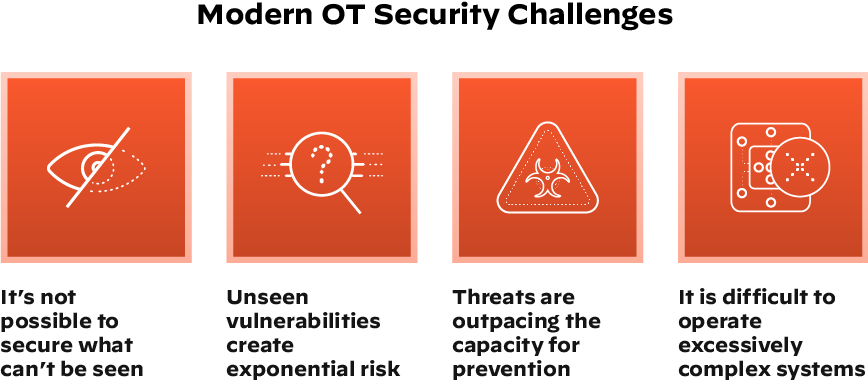
Figure 2: Modern OT security challenges
Common OT Security Challenges and Cyber Threats
Industrial organizations face expanding attack surfaces as legacy equipment connects to enterprise software and cloud analytics platforms. Addressing these vulnerabilities requires specialized security controls capable of mitigating risk without interrupting live operations.
Unpatchable Legacy Infrastructure and Unencrypted Protocols
Legacy industrial controllers lack basic security controls, software encryption capabilities, and modern authentication mechanisms. Taking these systems offline for security patches risks operational downtime, while applying unsupported updates can void vendor warranties. Furthermore, legacy control protocols transmit commands in plaintext, making them vulnerable to unauthorized command injection and spoofing.
IT/OT Convergence and Expanded IIoT Attack Surfaces
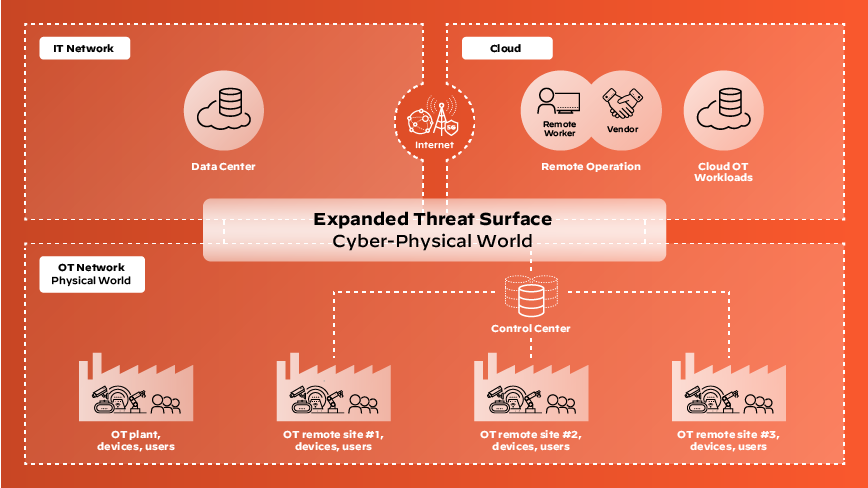
Digital transformation integrates corporate enterprise networks with plant-floor control systems to optimize operational analytics. Connecting industrial equipment to corporate IT networks exposes previously isolated controllers to internet-facing attack vectors. The rapid deployment of Industrial Internet of Things (IIoT) sensors further expands the attack surface, creating unmanaged entry points into critical control environments.
Industrial Ransomware and Targeted Malware Vectors
Threat actors deploy specialized malware designed to:
Alter physical controller logic
Disable safety instrumented systems
Encrypt operational databases
According to cybersecurity advisories from CISA, ransomware attacks targeting enterprise IT systems frequently force operators to shut down OT networks as a precautionary measure. Modern targeted threats bypass perimeter firewalls by abusing compromised vendor remote access tools and removable media.
Figure 3: Architecture of Cyber-Physical Environments
Key Components of an OT Security Strategy
A complete industrial cybersecurity framework provides total asset visibility, non-intrusive traffic inspection, and strict network segmentation. Deploying these core components protects physical operations while supporting operational productivity.
Passive asset discovery: Continuous inventory tracking maps every connected controller, HMI, and IIoT sensor without transmitting intrusive network scans.
Industrial microsegmentation: Granular zone isolation restricts network traffic between individual physical processes and enterprise networks.
Deep packet inspection: Specialized protocol analysis decodes proprietary industrial commands to detect unauthorized configuration changes.
Network-layer virtual patching: Inline security rules inspect and block known exploit attempts targeting unpatchable legacy controllers.
Zero trust remote access: Role-based access control enforces least-privilege policies for third-party vendors and field maintenance engineers.
Best Practices for Implementing Zero Trust OT Security
Implementing zero trust across operational environments requires a structured methodology that prioritizes physical safety and uptime. Following established implementation steps ensures comprehensive risk reduction without operational disruption.
Establish governance and cross-functional teams: Align IT security engineers, OT plant operators, and safety managers under a unified risk governance model.
Map physical asset inventories: Deploy passive monitoring tools to identify all physical devices, firmware versions, active protocols, and network connections.
Define functional security zones: Segment industrial operations into logical zones based on process criticality using the Purdue Model framework.
Enforce least-privilege access policies: Restrict user and vendor connections to specific applications, devices, and operational timeframes.
Deploy continuous threat monitoring: Analyze network control traffic using deep packet inspection to detect operational anomalies and unauthorized commands.
Implement virtual patching controls: Enforce inline network protection policies to block exploit attempts targeting known controller vulnerabilities.
Establish OT-specific incident response: Develop and test response playbooks that account for physical process isolation, safety procedures, and manual operation fallbacks.
Industrial Compliance and Standards Alignment
Industrial organizations must comply with stringent international frameworks designed to protect critical infrastructure from cyber threats. Aligning operational security policies with established standards ensures regulatory compliance and operational resilience.
NIST SP 800-82 Rev 3
Published by the National Institute of Standards and Technology, NIST SP 800-82 Rev 3 provides specific guidance for securing industrial control systems. The framework details risk management strategies, security architecture recommendations, and operational controls tailored to cyber-physical environments.
ISA/IEC 62443
The ISA/IEC 62443 standard is the international benchmark for industrial automation and control system security. It defines structured security requirements for operators, system integrators, and equipment vendors, emphasizing zone-and-conduit segmentation to contain security incidents.
Operational technology (OT) in security refers to the hardware and software systems used to monitor, manage, and control physical devices, machinery, and industrial processes.
IT security focuses on protecting data confidentiality, software applications, and enterprise networks, whereas OT security prioritizes physical safety, operational availability, and process reliability across machinery and control hardware.
Zero trust prevents lateral threat movement by requiring explicit authorization, continuous trust verification, and deep packet inspection for every connection across converged IT and OT networks.
Many legacy PLCs cannot accept patches directly or be rebooted without halting physical processes; security teams utilize network-layer virtual patching to block exploit attempts at the firewall level without disrupting machinery.
OT security platforms monitor proprietary industrial protocols including Modbus, DNP3, OPC UA, PROFINET, BACnet, and EtherNet/IP to detect unauthorized commands and traffic anomalies.